

Disclaimer: This content is for informational purposes only and does not constitute legal advice. Consult your own legal counsel before acting on any information provided.
A music license certificate is often treated as a small administrative document, but it can carry a lot of weight. When a brand, platform, production company, distributor or internal business affairs team needs proof that a use has been cleared, the certificate may be the fastest way to answer a practical question: who licensed what, to whom, for which use, in which territory and for how long?
That does not mean a certificate should replace the actual license agreement. In most professional music transactions, the certificate is better understood as a concise proof document that summarizes the permission granted under a signed license. If it is vague, inconsistent with the agreement or missing key rights information, it can create confusion at exactly the moment when a team needs certainty.
For labels, publishers, artist managers, sync teams and legal departments, strong certificate drafting is part of good music rights management. It supports clearance, enforcement, royalty collection and future diligence when a catalog changes hands.
What is a music license certificate?
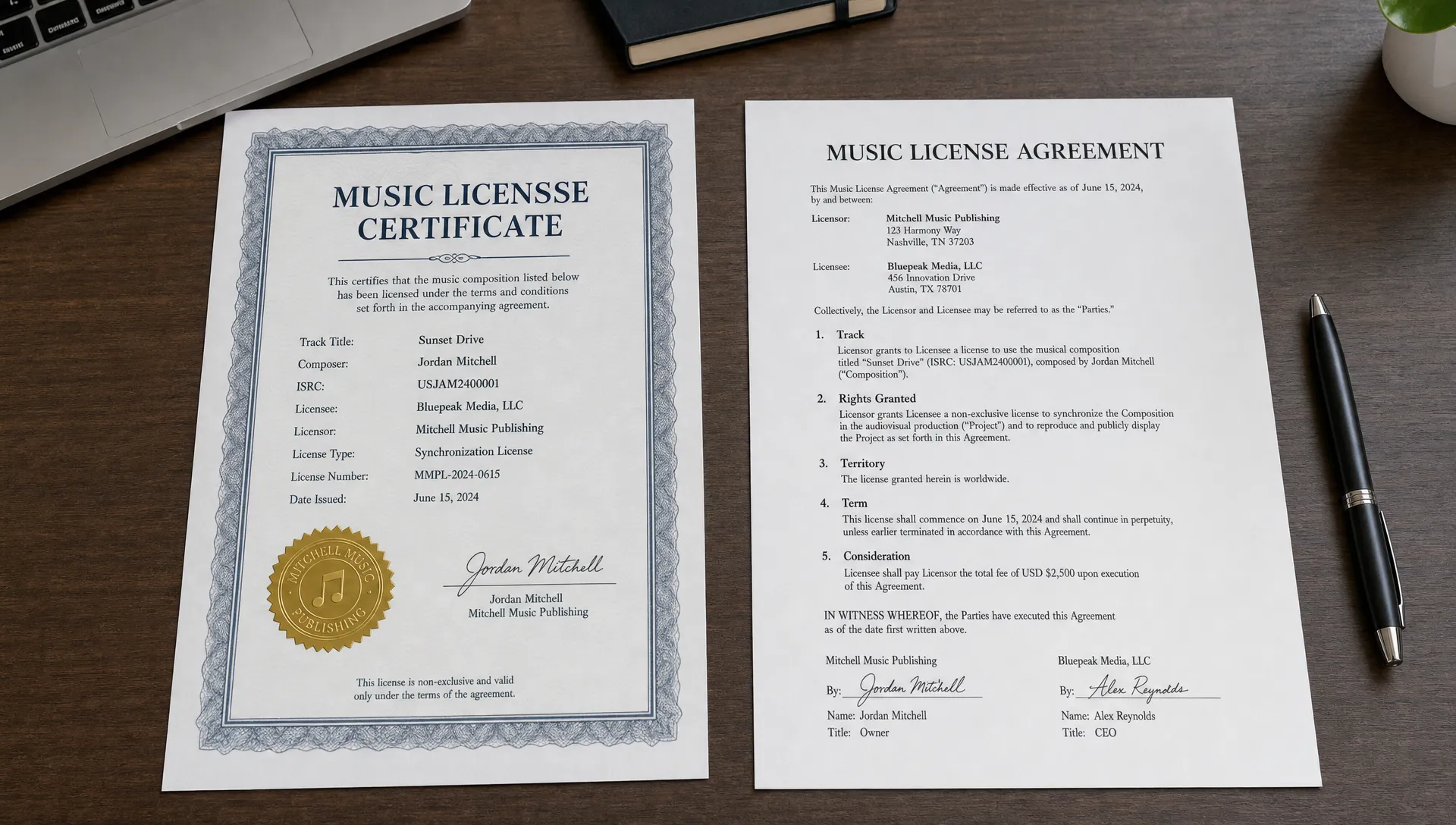
A music license certificate is a document confirming that a specific party has permission to use a specific musical work, sound recording or catalog under defined conditions. It usually sits alongside the actual contract, purchase order, platform license, synchronization agreement or master use license.
The certificate is commonly used to provide quick evidence of authorization to third parties. For example, a brand may need to show a media buyer that music in an ad campaign was cleared. A production company may need to provide proof to a broadcaster. A catalog owner may need organized records before a sale, audit or royalty review.
In music, the certificate must be especially precise because most commercial uses involve more than one right. A single track can include a sound recording copyright, one or more composition copyrights, publishing shares, neighboring rights and performer rights depending on the territory and use case. If the certificate states only that “the song is licensed” without identifying which rights are covered, it may not be enough.
If your team needs a broader refresher on the underlying rights, this guide to how modern music licenses actually work explains the difference between master rights, composition rights and common music license types.
Music license certificates should match the underlying agreement
The most important rule is simple: music license certificates should not say more than the actual license says. A certificate is a confirmation, not a shortcut to broader rights.
If the underlying license is limited to paid social ads in the United States for six months, the certificate should not imply worldwide, all-media, perpetual use. If the license covers only the master recording, the certificate should not suggest that the composition has also been cleared. If the license is subject to payment, approvals or delivery of cue sheets, the certificate should reflect those conditions.
This alignment matters because certificates often travel farther than the contract. They may be forwarded to agencies, distributors, platform teams, investors, production counsel or litigation counsel. A clean certificate can reduce back-and-forth. A loose certificate can become evidence of ambiguity.
Core information every certificate should include
A useful certificate begins with the basic transaction data. These details make the document searchable, auditable and easy to connect to a contract file.
Field | What to include | Why it matters |
|---|---|---|
Certificate title | “Music License Certificate” or a similarly clear label | Avoids confusion with invoices, deal memos or copyright registrations |
Certificate ID | Unique number or internal reference | Helps teams track versions and locate the matching agreement |
Issue date | Date the certificate was issued | Shows when the confirmation was created |
Effective date | Date permission begins | May differ from the issue date or signature date |
Underlying agreement | Contract name, date and parties | Connects the certificate to the binding legal document |
Licensor | Legal name and contact details of the rights owner or authorized representative | Identifies who granted permission |
Licensee | Legal name and contact details of the authorized user | Identifies who can rely on the license |
Authorized project | Campaign, production, product, episode, game, app or other use | Prevents reuse outside the approved context |
These details look basic, but they are often where disputes begin. A certificate issued to an agency may not automatically authorize every client affiliate. A certificate issued for a named campaign may not cover a later cutdown, sequel or regional adaptation. Precision at the top of the document avoids unnecessary interpretation later.
Identify the music precisely
A certificate should identify the licensed music in a way that leaves little room for confusion. Song titles alone are not enough. Many tracks have alternate versions, remixes, re-records, stems, edits, clean versions and live versions. A certificate should point to the exact asset or work being licensed.
For a sound recording, include the artist name, track title, version title, ISRC if available, label or owner, recording date if relevant and album or release information where useful. For a composition, include the title, writers, publishers, ownership shares where appropriate and ISWC if available.
Where the licensed use involves both master and publishing rights, the certificate should say so clearly. If only one side has been cleared, the document should avoid language that implies full clearance. For instance, “master recording license only” is much clearer than a general statement that the “music is licensed.”
For catalog owners preparing clearance packages, certificates should also align with the broader document set that proves ownership and authorization. A practical overview of those supporting records is covered in the legal documents every label should have.
State the rights granted, not just the use
A strong certificate describes the actual rights granted. This is where legal precision matters most, particularly for sync licenses, digital campaigns, UGC activations and branded content.
The certificate should identify whether the license includes synchronization, master use, reproduction, distribution, public performance, communication to the public, display, adaptation, editing, paid media usage or social platform usage. Not every transaction requires every right, but the document should not rely on shorthand when money and exposure are involved.
For example, a certificate for a television commercial may need to confirm sync and master use rights for the finished ad, plus the right to distribute and publicly perform the ad through specified media. A certificate for a social campaign may need to specify organic posts, paid amplification, influencer posts, whitelisting, boosting, dark posts or platform-specific placements.
The certificate should also distinguish between exclusive and non-exclusive rights. If a brand received category exclusivity, competitor exclusion or first-use protection, that should be stated with care. If no exclusivity was granted, the certificate should not be silent in a way that invites assumptions.
Define the permitted media and platforms
Older license summaries often used broad phrases such as “internet use” or “digital media.” In the current market, those phrases are often too vague. A license for a YouTube pre-roll ad is not always the same as a license for TikTok Spark Ads, Instagram Reels, connected TV, in-app advertising or a brand’s owned website.
A certificate should define permitted media in business terms that match how the content will actually be distributed. It can use broad categories if the agreement does, but those categories should still be understandable to operational teams.
Common media categories include:
Broadcast television
Cable and satellite television
Theatrical exhibition
Streaming video services
Social media platforms
Paid digital advertising
Brand-owned websites and apps
Podcasts and audio advertising
Live events and trade shows
Internal corporate use
If a campaign includes paid ads, the certificate should say whether paid media is included. If influencers are involved, it should say whether third-party creator posts are authorized or whether the license is limited to the brand’s own channels. If UGC is part of the strategy, it should clarify whether consumer uploads, remixes, duets, stitches or sound reuse are covered.
Specify territory, term and renewal rights
Territory and term are among the first things a clearance reviewer will check. A certificate should state where the license applies and when it begins and ends.
The territory can be worldwide, a list of countries, a region such as North America or a platform-limited territory based on availability. If the territory is limited, the certificate should not use phrases that imply global use. For digital campaigns, consider whether the licensee has an obligation to geo-target or whether incidental spillover is permitted.
The term should include a start date and end date. If the license is perpetual, the certificate should say so only if the underlying agreement clearly grants perpetual rights. If the license has renewal options, those options should be described separately from the current active term.
A practical certificate can also include a short survival note for archival use. For example, some agreements allow a production to remain in internal archives after the active media term ends, but do not allow public distribution. That distinction should be visible to the people who manage content takedowns or archive access.
Include fees, royalties and payment status where appropriate
Not every certificate needs to show commercial terms. In some transactions, fees are confidential and should stay in the underlying agreement. In others, payment status is essential because the license does not become effective until payment clears.
The certificate should indicate whether the license is paid, royalty-bearing, gratis, promotional or subject to another compensation structure. If the license is conditional on payment, it should state that permission is effective only after payment is received or after all conditions are satisfied.
For royalty-bearing uses, the certificate should reference reporting obligations without trying to restate the full accounting clause. This can include royalty basis, reporting period, payee information or a cross-reference to the relevant section of the agreement.
Royalty language matters for future audits. If a license permits ongoing use across platforms, unclear reporting obligations can lead to missing revenue, double counting or disputes about whether a use was covered by a flat fee.
Note approvals, restrictions and prohibited uses
Music licenses often include restrictions that are just as important as the rights granted. A certificate that omits restrictions can mislead downstream teams into thinking a use is broader than it is.
Common restrictions include limits on political advertising, sensitive products, alcohol, cannabis, gambling, adult content, pharmaceuticals, weapons, religious messaging or artificial intelligence training. Some artists and writers also require approval for edits, lyric changes, association with certain brands or use in specific territories.
Certificates should also address alterations. If the licensee may edit the recording to fit timing, loop a section or use instrumental stems, state that. If the licensee may not remix, sample, re-record, isolate vocals or create derivative works, state that too.
Approvals should be operationally clear. A clause saying “subject to approval” is not enough for a production team facing a launch deadline. The certificate can identify what has already been approved, what still requires approval and who has authority to approve future edits.
Clarify sublicensing, affiliates and agency use
Many modern music uses involve more than one company. A brand hires an agency, the agency hires a production company, a media buyer places ads and influencers publish content through their own accounts. A certificate should clarify which of those parties are authorized to use the music.
If the license extends to affiliates, agencies, contractors, media partners or distributors, define the scope. If sublicensing is prohibited, say so. If third parties may use the music only to create, deliver or distribute the authorized project for the licensee, that limitation should be visible.
This is especially important for record labels, music publishers and investment funds that manage valuable catalogs. Broad affiliate and sublicense language can quietly expand use beyond the economics of the deal. Tight drafting protects catalog value without blocking routine campaign execution.
For deal teams reviewing broader contract language, this checklist of clauses that protect catalog value is a useful companion to certificate review.
Add representations, warranties and authority carefully
A certificate often includes a statement that the licensor has the authority to grant the rights described. That statement should be accurate and appropriately limited.
For example, if a publisher controls only 50 percent of a composition, the certificate should not imply that 100 percent of the composition is cleared. If a label controls the master but not the composition, the certificate should not provide a full music clearance warranty. If a licensing administrator signs on behalf of a catalog owner, the certificate should identify the basis of that authority.
The certificate can also include a statement that all rights are subject to the underlying agreement. This helps prevent the certificate from being read as an independent grant that overrides negotiated terms.
A common formulation is to state that the certificate summarizes rights granted under the named agreement and, in the event of conflict, the underlying agreement controls. Counsel should adapt that language to the transaction and jurisdiction.
Preserve evidence and attach supporting materials
A certificate is stronger when it is connected to supporting materials. Depending on the transaction, attachments can include the executed agreement, approved creative, cue sheet, invoice, proof of payment, rights schedule, chain-of-title summary, metadata file or platform placement plan.
For uses that may later require enforcement, the certificate should also make evidence collection easier. It can include campaign URLs, ad IDs, social handles, platform names, delivery dates, screenshots, media files or hashes where appropriate. These details help prove what was authorized and what was not.
The goal is not to turn a certificate into a massive file. The goal is to make sure a reviewer can connect the certificate to the actual use. A one-page certificate with clean references is often better than a long document that repeats contract language poorly.
Sample structure for a music license certificate
The right format depends on the transaction, but a practical certificate usually follows a predictable structure. Legal teams can adapt the following outline to their own templates.
Section | Purpose |
|---|---|
Header | Title, certificate ID, issue date and governing reference agreement |
Parties | Licensor, licensee and authorized representatives |
Licensed music | Exact sound recording and composition details, including identifiers |
Rights granted | Master, composition, sync, reproduction, distribution, performance or other rights |
Approved use | Project, campaign, production or platform use covered by the license |
Scope limits | Territory, term, media, platforms and exclusivity status |
Commercial terms | Fee, royalty status, payment condition or reference to confidential agreement terms |
Restrictions | Prohibited uses, approval rights, edit limits and brand category limits |
Third-party use | Affiliates, agencies, contractors, influencers or sublicense rules |
Evidence | Attachments, approved creative, URLs, ad IDs or cue sheets |
Conflict clause | Statement that the underlying agreement controls if terms conflict |
Signature | Authorized signer, title, company and date |
Templates are helpful, but certificates should not become rote paperwork. Every line should answer a real clearance question or reduce a real operational risk.
Common mistakes to avoid
The most common certificate mistake is overbreadth. Teams issue a certificate that sounds simple and client-friendly, but accidentally grants more rights than the agreement allows. Phrases such as “all rights cleared,” “unlimited use” and “fully licensed” should be used only when they are strictly true.
Another mistake is failing to separate master and composition rights. A brand may receive a certificate from a label and assume it covers publishing. A platform may receive a publisher confirmation and assume the recording is cleared. Certificates should make this distinction unmistakable.
Outdated media language is also a problem. If the deal covers social platforms, paid ads or creator content, the certificate should not rely on broad legacy terms unless the underlying agreement uses them intentionally.
Finally, teams sometimes forget version control. If a license is amended, extended or partially terminated, old certificates can keep circulating. Each certificate should have a version number or replacement language so business affairs teams know which one is current.
When should a certificate be issued?
A certificate is most useful when a license will be relied on by people who are not reading the full contract. That includes ad operations teams, platform reviewers, distributors, broadcasters, agencies, investors and internal catalog administrators.
In many workflows, the certificate is issued after the agreement is signed and any required payment or approval condition has been satisfied. In fast-moving commercial campaigns, a conditional certificate may be issued earlier, but it should clearly state what must happen before the license becomes effective.
Certificates are also useful during catalog diligence. Buyers and lenders often want to know whether key tracks are subject to existing licenses, exclusivities or revenue-sharing obligations. A well-organized certificate archive can reduce diligence friction and help preserve value during a transaction.
FAQ
Is a music license certificate the same as a license agreement? No. A certificate usually summarizes or confirms rights granted under a separate agreement. The signed license agreement should control the legal relationship unless the parties expressly agree otherwise.
Can a certificate prove that both master and publishing rights are cleared? Yes, but only if it clearly identifies both rights and the licensor has authority to grant or confirm them. If only one side is covered, the certificate should say so.
Should a certificate include the license fee? It depends on the workflow and confidentiality obligations. Some certificates state that the license is paid or subject to payment without listing the amount. Others include fee details because finance, audit or platform review teams need them.
Who should sign a music license certificate? The signer should be someone with authority to bind or confirm rights for the licensor, such as an authorized officer, business affairs representative, licensing administrator or attorney-in-fact. The signer’s name, title and company should be included.
Do social media uses need special certificate language? Often, yes. Social campaigns may involve paid amplification, influencer accounts, remixes, platform tools, UGC and short-form edits. The certificate should reflect the actual use rather than using vague digital media language.
Final takeaway
Music license certificates work best when they are clear, narrow and traceable. They should identify the parties, the music, the rights granted, the approved use, the term, the territory, the media, the restrictions and the agreement they summarize.
For rights holders, a strong certificate protects against unauthorized expansion of a deal. For licensees, it gives operational teams confidence that the use they are distributing has been cleared. For investors and catalog managers, it creates a cleaner record of how assets are being exploited.
The certificate is not just paperwork. It is a control point in the lifecycle of a music asset, and drafting it carefully can prevent licensing disputes before they start.
What data do I need to provide to get started?
Are you a law firm?
How do you know the difference between UGC and advertisements?
How does Third Chair detect IP uses?
What is your business model?
What platforms do you monitor?
How do you know what is licensed and what isn’t licensed?